
How Educators Recover After Hard Moments Without Carrying Them All Day

Teaching doesn’t usually exhaust people in dramatic ways but it can wear you down quietly.
A moment with a student that lingers. A lesson that doesn’t land the way you hoped. A stretch of the day where you’re holding a lot emotionally, cognitively, or relationally and there’s no real pause button.
What makes teaching unsustainable isn’t having hard moments.
It’s moving from one emotionally demanding moment to the next without tools to reset inside the day.
Most educators don’t need more grit. They need ways to recover while still teaching.
Below are five recovery practices designed specifically for educators. Not generic self-care, but strategies that fit the reality of classrooms, including elementary settings where you’re with the same group of students all day.
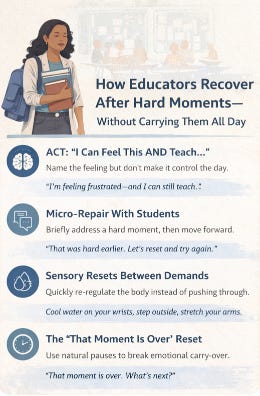
1. ACT Practice: Making Room Without Fixing
(“I can feel this and still teach.”)
Educators are often taught—explicitly or implicitly—to push emotions aside and power through.
ACT offers a different approach: make room instead of fighting.
When frustration, worry, or disappointment shows up, try saying silently:
“I’m feeling frustrated right now—and I can still teach.”
You’re not approving of the feeling.
You’re not trying to make it go away.
You’re reminding yourself that discomfort doesn’t get to run the day.
This creates psychological flexibility—the ability to keep acting in line with your values even when things feel messy or imperfect.
2. Micro-Repair With Students
(It’s powerful to admit when you were wrong)
One of the biggest energy drains in teaching is carrying moments that didn’t feel good.
Repair helps close those emotional loops.
Sometimes repair is as simple as:
“That didn’t feel great a few minutes ago. Let’s reset and try again.”
Or:
“I got frustrated earlier. Thanks for sticking with me.”
This doesn’t undermine authority.
It builds trust—and it often releases your tension as much as the students’.
As I share in Happy & Resilient, repair teaches more than flawless teaching ever could. It models emotional intelligence in real time.
3. Sensory Resets Between Demands
(Regulating without stopping instruction)
Teachers rarely get long breaks—but sensory input can reset the nervous system quickly.
Examples that fit real school days:
Splash cool water on your wrists at the sink
Step outside for 60 seconds and feel the air
Stretch your arms overhead and roll your shoulders while students transition
These brief inputs signal safety to the nervous system and help prevent stress from piling up.
Small resets, repeated often, protect energy far more effectively than one big break you may never get.
4. The “That Moment Is Over” Reset
(Especially important for elementary teachers)
For middle and high school teachers, one class ends and another begins.
For elementary teachers, the reality is different—you’re often with the same group of students all day, even though the day includes transitions, recess, specials, or independent work.
That makes emotional recovery just as important—but it has to look different.
During a natural pause in the day, try this:
Put both feet on the floor
Take one slow breath in, longer breath out
Say silently: “That moment is over.”
You’re not erasing what happened.
You’re preventing it from coloring the rest of the day.
This practice helps educators avoid carrying one hard moment into the next hour, lesson, or interaction.
5. End-of-Day Containment Ritual
(So teaching doesn’t follow you home)
Many educators replay the hardest moments of the day long after leaving campus.
Before you head home, try this brief practice:
Name one moment that was hard
Name one moment that mattered
Write it down or say it aloud in the car.
This helps your brain store the day accurately—not just through the lens of stress.
Positive psychology research shows that intentionally naming meaning alongside difficulty reduces emotional exhaustion over time.
Teaching is demanding because it’s human work.
You don’t need to care less to survive it.
You need ways to close emotional loops, reset between demands, and come back to yourself during the day—especially when you don’t get clean breaks.
I work with educators, schools, and districts to support sustainable energy, emotional intelligence, and joyful, human-centered cultures. If your school or district is looking for support and you’d like to chat, feel free to reach out.