
2/3 Specific Mindfulness Practices that I love and recommend that you try!

Mindfulness is the practice of being present and fully engaged in the current moment without judgment. It can help students develop self-awareness, self-regulation, and resilience. Thus, students can learn to be more present, focused, and engaged in their learning, leading to better academic performance and overall well-being. Here are some specific mindfulness practices that can be helpful in a classroom setting:

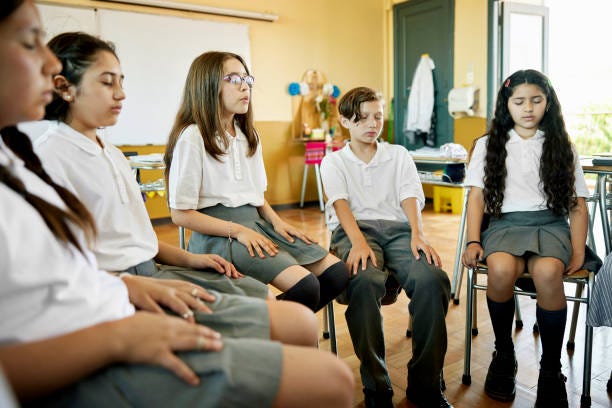
Practice #2 - Noting (3 minutes to 12 minutes)
It is often difficult to pay attention to a breath over and over again without consistent reminders. It’s, therefore, worth exploring a technique called “noting.” The noting technique slightly stimulates our memory which often allows us to keep track of where we were just a second ago and not lose ourselves in our thoughts.
Find a comfortable position on your chair with your back straight, the palms of your hands on your legs or your table, and your legs and arms uncrossed. If you are not too tired, close your eyes. Otherwise, keep your eyes half open, and gaze at the floor. Take a few deep, mindful breaths, in and out, and allow yourself to feel relaxed, yet alert.
Give yourself a few moments to breathe normally at your own pace and then begin practicing with the “noting” technique. At the end of your next inhalation, mentally count “one” and, at the end of your next exhalation, mentally count “two.” Then again, count “one” at the end of the inhale and “two” at the end of the exhale. Continue the practice for the next few moments.
If you notice that you stopped counting because thoughts floated into your head, that’s okay. Be gentle with yourself and come back to practice.
P. S. Get more of these exercises in my book.